
How Ayurvedic Syrups Are Manufactured: Process and Quality Checks
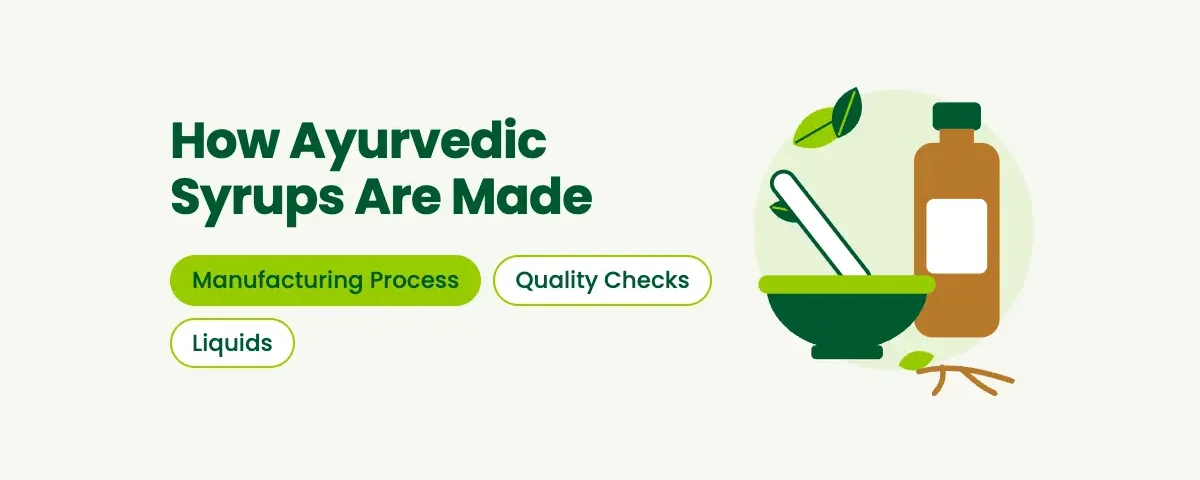
Ayurvedic syrups and tonics are among the best-selling products for PCD companies, pharma brands and direct-selling businesses. They are easy to take, familiar to customers and suit everything from digestive care to family wellness. But behind every bottle is a careful process. Understanding the Ayurvedic syrup manufacturing process helps brand owners ask the right questions, compare manufacturers properly and set realistic expectations for quality, timelines and shelf life.
This guide walks through how Ayurvedic syrups are made, the quality checks that matter, and what to look for in a liquid manufacturing partner.
Types of Ayurvedic liquid preparations
| Type | How it is made | Shelf life under the 2016 rules* |
|---|---|---|
| Syrups and sharbat (sharkara, panak) | Herbal extracts or decoctions combined with a sugar base | 3 years |
| Liquid decoctions (pravahi kwath) | Concentrated herbal decoctions in liquid form | 3 years |
| Asava and arishta | Traditional fermented preparations | 10 years |
| Arka | Distilled herbal waters | 1 year |
*Under Rule 161-B as notified in 2016, unless stability data supports a different period. The rules were amended again in 2026, so confirm the current position. Read more in our guide to the shelf life of Ayurvedic medicines.
The Ayurvedic syrup manufacturing process, step by step
1. Raw material sourcing and identification
Every herb is checked for identity and quality before use, against standards such as those of the Pharmacopoeia Commission for Indian Medicine & Homoeopathy. Using the correct, good-quality herb is the foundation of a consistent product.
2. Cleaning and size reduction
Herbs are cleaned to remove foreign matter, dried where needed and reduced to the right particle size for extraction.
3. Extraction or decoction
The herbs are processed to draw out their active constituents, often by boiling in water to make a decoction (kwath) as described in classical texts, or by using standardised extracts. Time, temperature and herb-to-water ratios are controlled carefully.
4. Filtration
The decoction is filtered to remove plant residue and give a clear, consistent liquid.
5. Syrup base preparation and mixing
A sugar or other permitted base is prepared, and the herbal extract is blended in. Permitted preservatives, flavours and colours are added where the formula allows, then the batch is mixed until uniform.
6. In-process quality checks
The batch is checked for parameters such as appearance, taste, pH, density and viscosity before it moves to filling.
7. Filling, sealing and labelling
The syrup is filled into clean bottles, sealed with tamper-evident caps and labelled with the required details, including batch number, manufacturing and expiry dates.
8. Finished product testing and release
Samples from each batch are tested before release, and records are kept so every bottle can be traced back to its batch.
Quality checks that matter most
| Check | Why it matters |
|---|---|
| Herb identity and quality | Wrong or poor-quality herbs undermine the whole product |
| Consistency of extraction | Keeps strength and taste the same from batch to batch |
| pH, density and viscosity | Indicate the batch has been made to specification |
| Microbial quality | Liquids need careful hygiene to stay safe through their shelf life |
| Fill volume and sealing | Protects customers and your reputation |
Common syrup problems and how good manufacturers prevent them
| Problem | Usual cause | Prevention |
|---|---|---|
| Sediment or cloudiness | Incomplete filtration or ingredient interactions | Controlled filtration and formulation checks |
| Taste or colour varying between batches | Inconsistent herbs or extraction | Raw material checks and fixed process parameters |
| Fermentation or spoilage | Hygiene gaps or poor sealing | GMP hygiene, correct preservation and tamper-evident sealing |
| Leaking bottles | Poor cap fit or sealing | Matched bottle-cap combinations and fill checks |
| Short fill | Uncalibrated filling | Regular fill-volume checks during production |
Packaging choices for Ayurvedic syrups
- PET bottles: light, shatter-resistant and cost-efficient for most syrups
- Amber glass bottles: premium look and light protection
- Tamper-evident caps and measuring cups for safety and correct dosing
- Cartons for shelf presence and protection in transit
What to ask a liquid manufacturing partner
- Is your liquids section GMP certified, and what is your daily capacity?
- How do you check herb identity and quality before production?
- Which in-process and finished-product checks do you run on every batch?
- What shelf life applies to my product, and on what basis?
- Which bottle and cap options do you offer, and what is the timeline from approval?
Getting your paperwork in order? See the documents required for Ayurvedic third party manufacturing.
Ayurvedic syrup manufacturing at MAC Biosciences
MAC Biosciences manufactures Ayurvedic liquids in-house, with a daily capacity of 15,000 bottles, in its GMP and WHO-GMP certified, ISO certified facility in Panchkula, Haryana. We have manufactured for 100+ companies in Ayurvedic third party manufacturing since 2013, offer 300+ formulations including syrups and tonics, and typically deliver within 30 to 40 days of formula and artwork approval. Explore our Ayurvedic third party manufacturing services.
Frequently asked questions
How are Ayurvedic syrups made?
Herbs are checked, cleaned and processed into a decoction or extract, filtered, blended into a syrup base with permitted ingredients, checked in-process, filled and sealed, then tested before release. Classical preparations follow methods described in Ayurvedic texts.
What is the shelf life of an Ayurvedic syrup?
Under the 2016 Rule 161-B table, sharkara, panak and sharbat preparations have a shelf life of 3 years, and asava and arishta have 10 years, unless stability data supports a different period. Check the current rules for your product.
What is the difference between a syrup and an asava or arishta?
Syrups are usually herbal extracts in a sugar base. Two methodologies i.e., Asava and arishta are traditional fermented preparations made by a different process, and they have a much longer shelf life under the rules.
Can I launch my own brand of Ayurvedic syrup?
Yes. Through third party manufacturing, a licensed manufacturer produces the syrup under its licence and you market it under your brand. Choose a ready formulation for a faster launch or develop a custom one.
Which bottle is best for an Ayurvedic syrup?
PET bottles suit most syrups and keep costs and breakage down, while amber glass offers a premium look and better light protection. Choose based on your channel, price point and the product’s needs.
How long does it take to manufacture a batch of Ayurvedic syrup?
Production itself is part of a longer timeline that includes formula approval, artwork, packaging and testing. With ready formulations and approved artwork, an experienced manufacturer typically delivers within 30 to 40 days.
Launch your Ayurvedic syrup range
Share your product list, preferred bottle sizes and launch quantity, and we will suggest formulations and send a quote. Contact MAC Biosciences today.

 Home
 Range
 Call Us
 Whatsapp
 Contact Us