
Monopoly Rights in an Ayurvedic PCD Franchise: What to Check Before You Sign
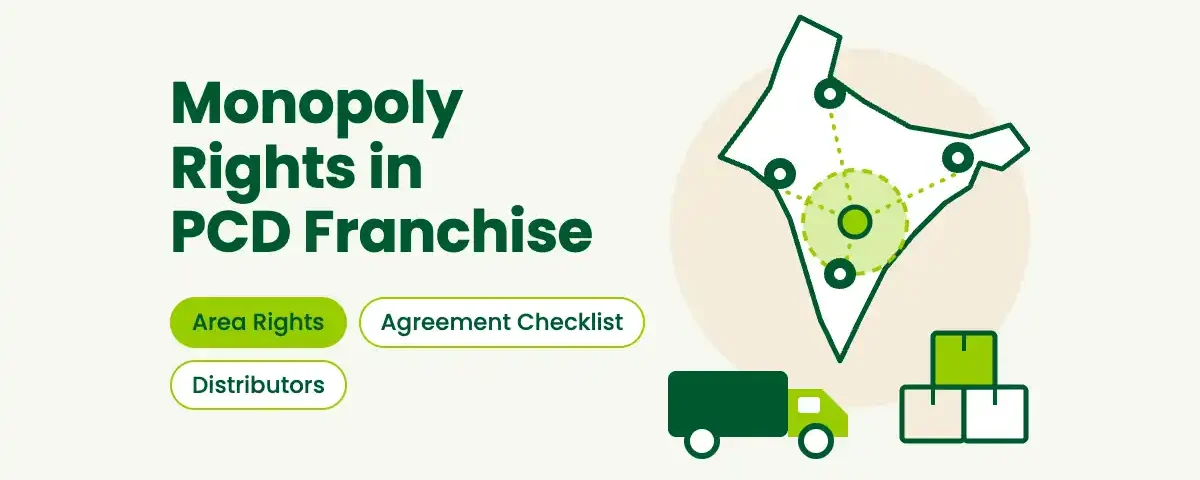
Monopoly rights are one of the biggest reasons distributors choose a PCD franchise. If you are the only distributor of a company’s products in your district, every doctor, chemist and retailer you develop becomes your business, not someone else’s. But monopoly rights in a PCD franchise are only as strong as the agreement behind them. A verbal promise or a vague line in an email will not protect you when another distributor starts supplying in your area.
This guide explains what monopoly rights cover, the conditions companies usually attach, and the clauses to check before you sign an Ayurvedic PCD franchise agreement.
What are monopoly rights in a PCD franchise?
Monopoly rights (also called exclusive or area rights) mean the company agrees to appoint only you to promote and distribute its products in a defined territory, such as a district, a city or a set of towns. In return, you commit to promoting the range actively and meeting agreed purchase levels.
For a distributor, monopoly rights mean:
- No competition from the same brand in your area, so your effort with doctors and chemists is not undercut
- Stable pricing, because no one else is selling the same products cheaper in your territory
- A business you can build over years, with repeat orders that stay with you
Monopoly vs non-monopoly franchise
| Monopoly franchise | Non-monopoly franchise | |
|---|---|---|
| Other distributors in your area | None for the agreed products | Possible |
| Commitment expected from you | Usually purchase targets and active promotion | Usually lower |
| Price protection | Stronger | Weaker |
| Best for | Distributors with a doctor and chemist network ready to grow | Testing a market or adding a few products to an existing business |
Conditions companies usually attach
Exclusive rights come with responsibilities. Expect some or all of these:
- Minimum purchase targets, monthly or quarterly, to keep the rights active
- A defined product list that the rights apply to, which may not include every product the company makes
- A time period, often reviewed every year
- Payment terms, such as advance payment or a fixed credit period
- Promotion commitments, such as regular doctor visits or using the company’s promotional material
These conditions are reasonable. The company is giving up the option of appointing other distributors in your area. What matters is that they are realistic for your market and written down clearly.
Clauses to check in your agreement
1. The exact territory
“Your city” is not enough. The agreement should name the district or towns, and say whether nearby areas or highways are included. Ambiguous boundaries are the most common source of disputes.
2. Which products are exclusive
Check whether the rights cover the full range or only certain products, and what happens when the company launches new products. Ask for new launches to be offered to you first in your territory.
3. Targets and what happens if you miss them
Targets should be realistic for your area. The agreement should say what happens if you fall short. Ideally that means a warning period or a review, not immediate loss of rights.
4. Duration and renewal
Check how long the rights last and how they are renewed. Automatic renewal when you meet your targets gives you the security to invest in building the market.
5. Other sales channels
Ask how the company handles institutional sales, hospital supplies and online orders in your territory. Clarify whether these count towards your targets or fall outside your rights.
6. Prices, schemes and returns
Your agreement or price list should cover your purchase prices, MRPs, any schemes, and the policy on near-expiry, breakage and damaged stock.
7. Termination and notice
Check the notice period either side must give, and what happens to unsold stock if the arrangement ends.
How to verify a company before you sign
- Ask for the agreement in writing, on company letterhead and signed by an authorised person. Check whether your state’s stamp duty rules apply to the agreement.
- Check existing distributors in your area. Ask chemists whether the brand is already supplied locally.
- Verify the manufacturer. Ask where the products are made and which certifications the plant holds, such as GMP and WHO-GMP.
- Ask for references from distributors in other districts, and speak to them about supply times and how disputes were handled.
- Read the full agreement before paying. If anything is unclear, ask for it to be clarified in writing. Agreements in India are governed by the Indian Contract Act, 1872 (see India Code), so a short review by a local advocate is worth the cost for a long-term arrangement.
Red flags to watch for
- Monopoly promised verbally but missing from the written agreement
- Territory described vaguely, such as “your region”
- Targets that are far higher than what the area can realistically sell
- No clear policy on expiry, returns or supply timelines
- Pressure to pay a large amount before you see the agreement
For the bigger picture on starting out, read our guide on how to start an Ayurvedic PCD franchise.
Ayurvedic PCD franchise with MAC Biosciences
MAC Biosciences offers 120 own-brand Ayurvedic products to franchise partners, manufactured in our GMP and WHO-GMP certified facility in Panchkula, Haryana. We have been manufacturing since 2013, our founder brings more than 25 years of industry experience, and we are expanding our franchise network, especially in North and South India. Explore our Ayurvedic PCD franchise opportunity, or read about partnering with us for an Ayurvedic medicine franchise.
Frequently asked questions
What does monopoly rights mean in a PCD franchise?
It means the company appoints only you to promote and distribute its products in a defined territory. No other distributor of the same brand should supply those products in your area while your rights are active.
Is monopoly better than a non-monopoly PCD franchise?
For distributors with an established doctor and chemist network, monopoly rights usually offer better long-term value because your market stays yours. If you are testing a new area or adding a few products, a non-monopoly arrangement can be a lower-commitment start.
Can a company cancel my monopoly rights?
It depends on your agreement. Rights are usually linked to conditions such as purchase targets and payment terms. Check what triggers cancellation, the notice period and whether you get a chance to correct a shortfall first.
Do monopoly rights cover online sales?
Not automatically. Many agreements treat online, hospital and institutional sales separately. Ask the company how these are handled in your territory and get the answer written into the agreement.
Should a monopoly agreement be on stamp paper?
A written, signed agreement is essential. Whether stamp duty applies and at what value depends on your state’s rules, so check locally or with an advocate before signing.
Looking for exclusive rights in your area?
Tell us your district and the product categories you are interested in, and we will share our product list and franchise terms. Contact MAC Biosciences to discuss your territory.




 Home
 Range
 Call Us
 Whatsapp
 Contact Us